Personal JOurneys
At International House West Flanders, we are excited to connect with people from all corners of the world. Many internationals have been living in West Flanders for some time. Get inspired and gain valuable insights by reading their stories!
Reference: Voka: West-Vlaanderen Ondernemers 2024
Featured Stories
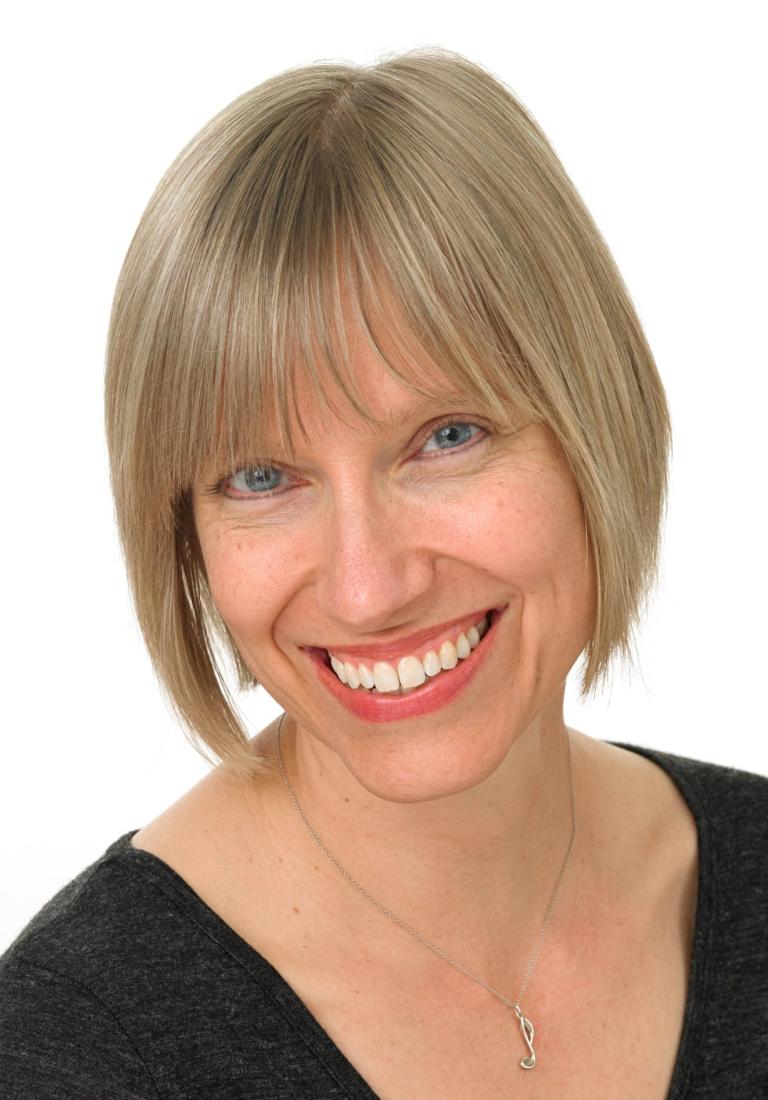
Sara Schneider
KMFA
From USA
I was born in Michigan in the US, but I've been living in Austin, Texas for the past 25 years. I arrived in Belgium May, 2025. It's been a dream of mine to move back to Europe (I earned my master's degree, or doctorandus as it was called back then, at the University of Amsterdam in 1999) and finally the stars aligned to make it possible.
I moved to Belgium, and Bruges specifically, so that I could conduct research and write my second novel, which is set in 15th century Bruges.
I work for an independent classical radio station based in Austin, KMFA Classical 89.5. (www.kmfa.org) During the pandemic we learned that radio can be done (and done well!) 100% remotely, so I asked my bosses if they'd entertain the idea of me working from Belgium.
To my delight, they said yes! I have a daily airshift (3-7 pm local time Monday through Friday), and I also program my shift along with several others. In addition, I produce and host a weekly show called Early Music Now, which is syndicated and heard on dozens of stations all over the US. I hear from listeners as far away as Vermont and Washington State, and once I caught my own show while channel-surfing during a road trip through Oklahoma, which was very fun! The show focuses on music of the Middle Ages, Renaissance, and early Baroque, from approximately the year 1000 A.D. to 1700.
That's another reason I was so keen to live in Belgium- there's a thriving early music scene here, and historically, Belgium and northern France were fertile fields for musical talent. For about 200 years, roughly between 1400-1600, this region produced almost every great composer on record. Singers and composers were exported from this tiny geographic area all over Europe, shaping musical tastes at courts and cathedrals from Spain to Italy to Central Europe. In Italy they had their own nickname: Oltremontani, "those who come from over the mountains", and in Spain Emperor Charles V's famous choir was called Capilla Flamenca.
Two Mottos that Inspire Me
I've always loved the Dutch saying "Nee heb je, ja kun je krijgen." There's no direct translation, but in English we say "Nothing ventured, nothing gained" which reflects the spirit of the Dutch saying.
Another motto I love originated right here in Bruges: Plus est en vous- there is more in you. It was the personal motto of Louis de Gruuthuse, a nobleman, councillor, and arts patron from 15th century Bruges. His palatial home is now a museum, and you can see his inspiring motto all over the place, including on the frame of an original portrait from the 15th century. 'Plus est en vous' reminds me that as human beings we're never finished, there's always more growing, learning, and evolving to do. That may not be what Louis had in mind, but that's how I choose to interpret it. ;-)
Past Work Experience or Life Inspiration
At age 20 I left the US to study abroad in the Netherlands, and the seven years I lived there were hugely influential, and shaped who I became as a person. Many aspects of life in Europe make much more sense to me than the stereotypical 'American way of life', with its urban sprawl and reliance on the automobile. You get to a certain age and start to take stock of your life, and after a couple of decades of driving everywhere I decided that I didn't want to sit in traffic anymore if I didn't need to! I'm now very happy to walk and ride my bike, or take public transportation.
Pathway from studying to working: I studied musicology at the University of Amsterdam, which is music studied from a research-based, academic perspective rather than composition or performance. After briefly considering a career in academia, I instead pivoted and opted for a career in classical radio. Radio is still a 'gateway experience' for many people, a low-pressure way to discover the riches of classical music. I love being a part of that voyage of discovery, and it helps to remember that no matter how many times I've heard a piece of music, someone else could be hearing that piece for the very first time and falling in love with it.
Company Support
KMFA has been very supportive during this time, giving me the freedom to follow a dream, and working with the seven-hour time difference! I feel like the move has affected my announcing in a positive away also; helping me to look at things through fresh eyes, while encouraging me to maintain links with Austin so I still sound local.
Living in Belgium
I really love it here. The people are friendly and helpful, travel is so convenient, and the connection to the past is a vital part of what makes Bruges so special. I'm writing about the 15th century, and trust me, there is almost nothing about our lives that anyone from the 15th century would recognize! But thanks to the splendid art of Van Eyck, Memling, Gerard David and others that is right in my 'back yard', churches like the OLV Kerk and Sint Salvator, and the handful of other 15th century buildings that still exist, I can at least glimpse their world. Along with thorough research and plenty of imagination, I do my best to recreate that world on the page for my readers.
I read a beautiful quote by the Buddhist monk, teacher, and poet Thich Nhat Hanh. He told a story about an event that made an impression on him, when he connected with people from the past 'in space but not in time'. That's how I feel every time I hit the streets of Bruges, and it's magical.
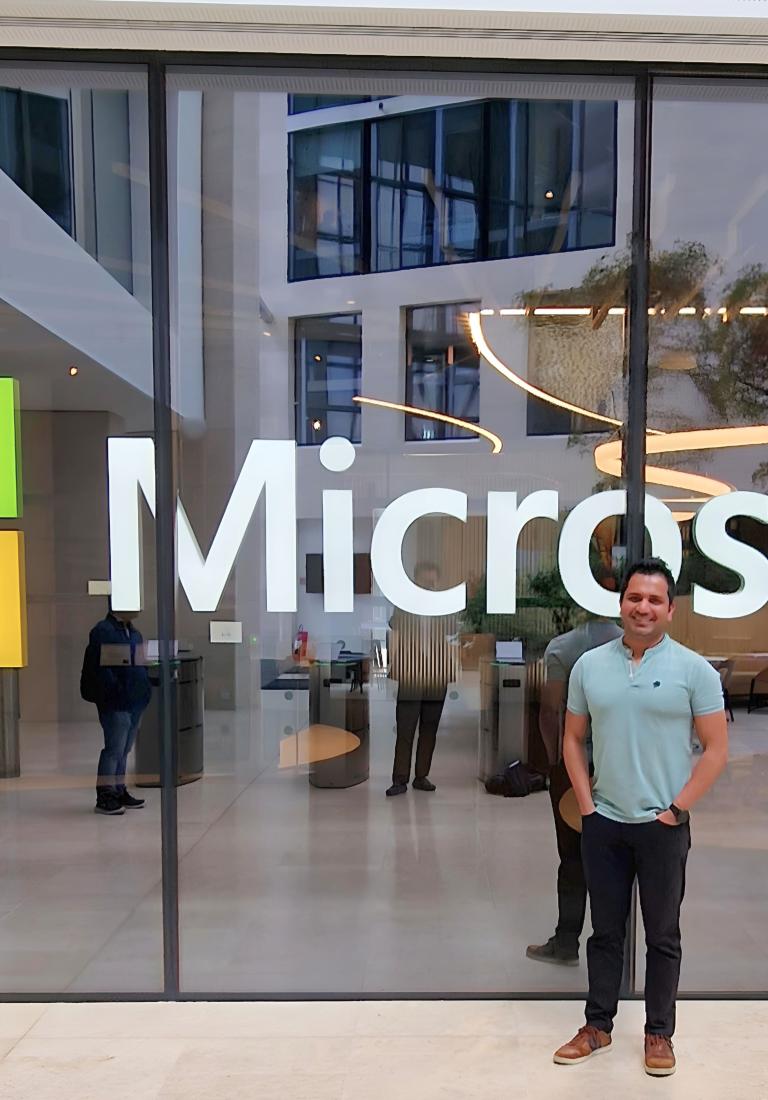
Ajay Kumar
Microsoft
From India
I am originally from India. I have been living in Belgium for 10 years. I moved to Belgium for better career opportunities and to challenge myself in an international environment. I am a senior software engineer at Microsoft, working on large-scale, secure software systems that support millions of users, including AI-driven solutions in healthcare.
“Growth begins when you choose courage over comfort.”
Early Inspirations & Human Values
My journey with technology began in India, shaped by a family that valued kindness, curiosity, and hard work. I was always fascinated by how software could help people, even in small ways, and that purpose kept guiding me forward. As I grew into engineering, I realized I wanted to work in a place where diverse cultures and ideas meet. That desire pushed me beyond my comfort zone and eventually toward an international career. Even today, no matter how complex the problems get, I remain grounded and empathetic, being human first. Kindness, respect, and resilience matter deeply to me. These values became the foundation for everything I pursued professionally.
Moving to Belgium with My Family
Ten years ago, my wife and I moved to Belgium with hope and ambition, unaware of how much it would shape our lives. The early years were a mix of excitement and quiet challenges, new culture, cold weather, and the difficulty of rebuilding a social circle from scratch. I missed India’s festivals, conversations, and familiar energy more than I expected. But slowly, resilience took over, and Belgium began to feel like a place where we could build something meaningful. Over time, we welcomed two children, which completely changed our journey. Watching them grow here made me appreciate the stability and security this country offers. Belgium didn’t just give us a home; it gave us a new beginning. It became a place where our family truly belongs.
Professional Growth & Personal Strength
My career in Belgium has challenged me in ways that have helped me grow, both technically and personally. Joining Microsoft pushed me to think bigger, take responsibility, and collaborate across cultures. I work on large-scale, secure systems, including AI-driven solutions in healthcare, with an impact reaching millions. The work is demanding, but it’s also meaningful. Through strict deadlines, complex problems, and steep learning curves, I learned the value of resilience. I also discovered that kindness and teamwork matter just as much as technical skill. These lessons shaped my leadership style and strengthened my confidence. Belgium played a significant role by giving me opportunities I once only hoped for.
Cultural Differences & Adaptation
Working in Belgium introduced me to a different pace and mindset. The focus on structure, clear communication, and work-life balance was very different from the fast-paced culture I grew up in. At first, the quietness felt strange, but over time, I began to appreciate its stability. I adapted by listening more, planning better, and valuing long-term thinking. At the same time, I brought my own strengths, warmth, perseverance, and a constant desire to learn. This blend of cultures enriched my professional life and relationships. It taught me patience and broadened my perspective. These differences are one of the most significant gifts of working internationally.
Belgium as Home & What It Gave Me
Belgium has given me far more than a career; it has shaped my family and my identity. It gave us a safe, stable place to raise our children and build our future. It taught me resilience through challenges and gratitude through everyday moments. I still miss India, the food, the festivals, the warmth, but Belgium brought its own comfort into my life. The quiet streets, the balance, and the sense of security slowly became familiar. Today, when I see my kids speak the local languages and adapt so naturally, I realize how deeply this country has become part of us. Belgium didn’t just host us; it helped us grow. For that, I remain truly grateful.
Anastasia Kim
Freelance
From Russia
I am an ethnic Korean born and raised in Russia. From an early age I lived between cultures and often felt like I did not fully belong anywhere.
Identity-Searching
Over the years I lived in Beijing and Hong Kong, and tried to settle in Saint Petersburg. I also spent time in Seoul hoping that there, among "my own people", I would finally feel at home. But even there I felt like a stranger. Over time I realized that identity is not a final destination but an ongoing search. Belonging is not simply about where you come from; it is something fluid and evolving, shaped by experiences and self-reflection.
Foundation & Contribution
The Russian language became my foundation and a way to stay connected to myself. That is why I chose to become a teacher. Today I help bilingual children preserve their language and find confidence in who they are even as they grow up in different cultural contexts.
Connection Through IHWF
For the past five years I have been living in Bruges. Here, through the IHWF, I finally felt something I had long been searching for. I found a group of people who understand what it means to come from different cultures. Surrounded by people from all over the world with their own complex stories and experiences I no longer feel the need to explain myself. Here I am simply accepted.
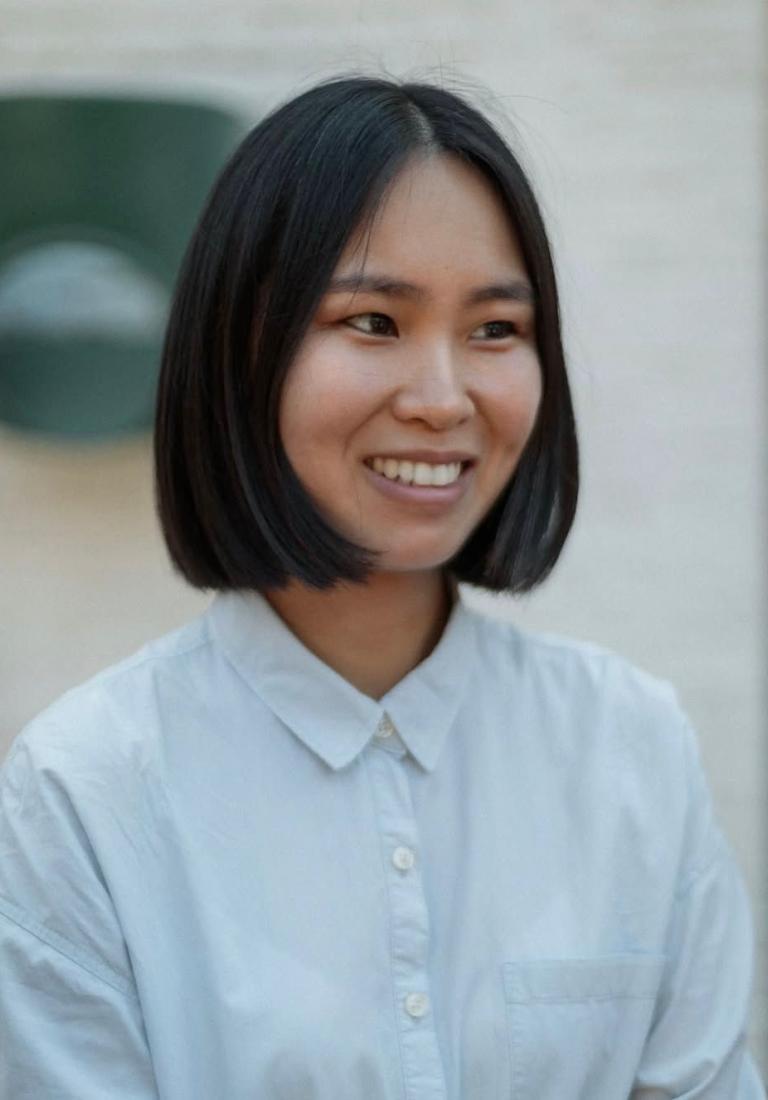
Kinga Lili Balogh
International House West Flanders
From Hungary
Originally from Hungary, with a background in business management, I combine my interest in international communities with practical skills in organization, communication, and project support. Over the past years, I have participated in exchange programs in the USA, Czechia, Romania, and Belgium. My journey in West Flanders began in Kortrijk, where I quickly fell in love with the region's international spirit and everyday charm.
I have always been curious about different cultures and loved making international connections. Living in different countries also taught me how powerful human connection can be. I can truly understand how other internationals feel when they come to our events. Every culture has its own rhythm and own stories to tell. Listening these stories and sharing my own have really changed the way I see the world.
I am proud to be a part of a team that helps others feel at home in the same way I once did. It has made me feel like I am giving something back to a place that gave me so much.
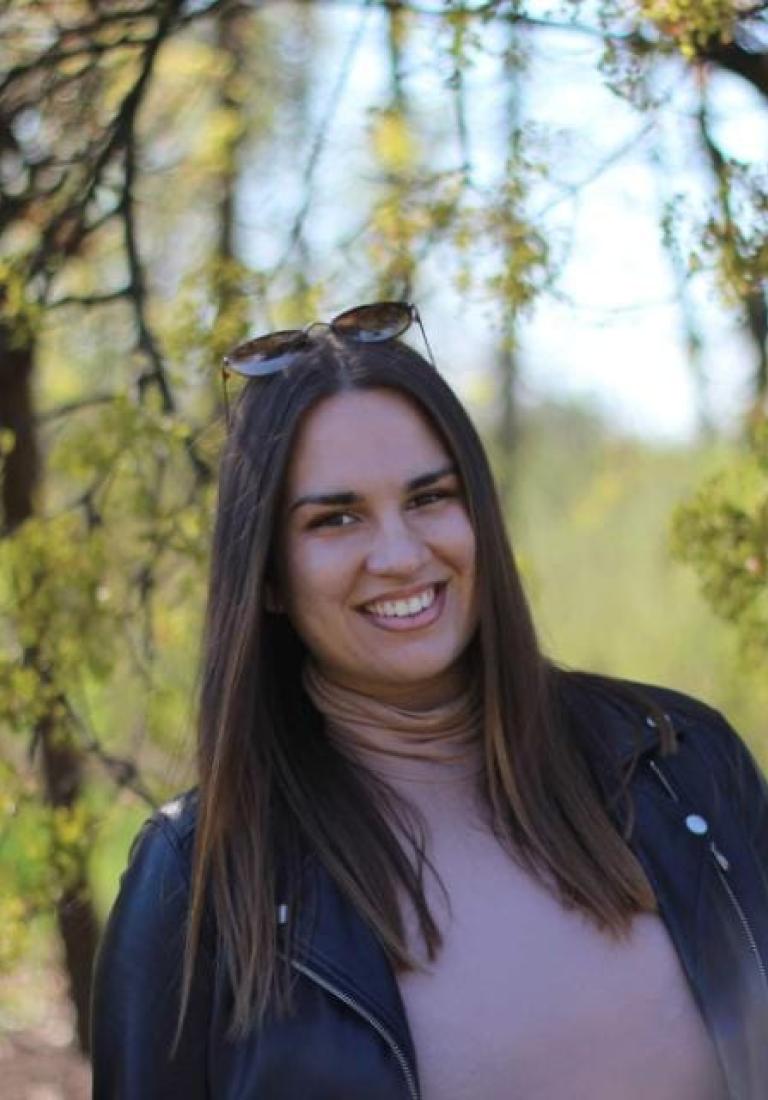
Alexandra Tokoutsi
Logi-technic
From Greece
Alexandra Tokoutsi is 30 years old and comes from Greece. She moved to Belgium with her husband, who came here for work, and she also found a job for herself. She is currently working as a technical design engineer at Logi-technic.
"I have been living in Belgium since November 2022. Since it is a member state of the European Union, I didn’t have to go through an extensive procedure to move here. When I arrived, I just had to apply for a Belgian identity card and open a bank account. I think that only took about a month. The recruitment agency that found the job for me, CTRL-f, helped me a lot with that.
It only took 2 months to find a new job here. In Greece, I had the same position. A lot depends on the sector you work in. For me, as an industrial design engineer, it wasn’t difficult to find a job, either in Greece or in Belgium.
Dutch is definitely a barrier, as I haven’t mastered it yet. I also find it challenging to connect with the local culture, although my colleagues in my current company do their best to make me feel part of the team. Of course, I miss my family, the weather, and the food."
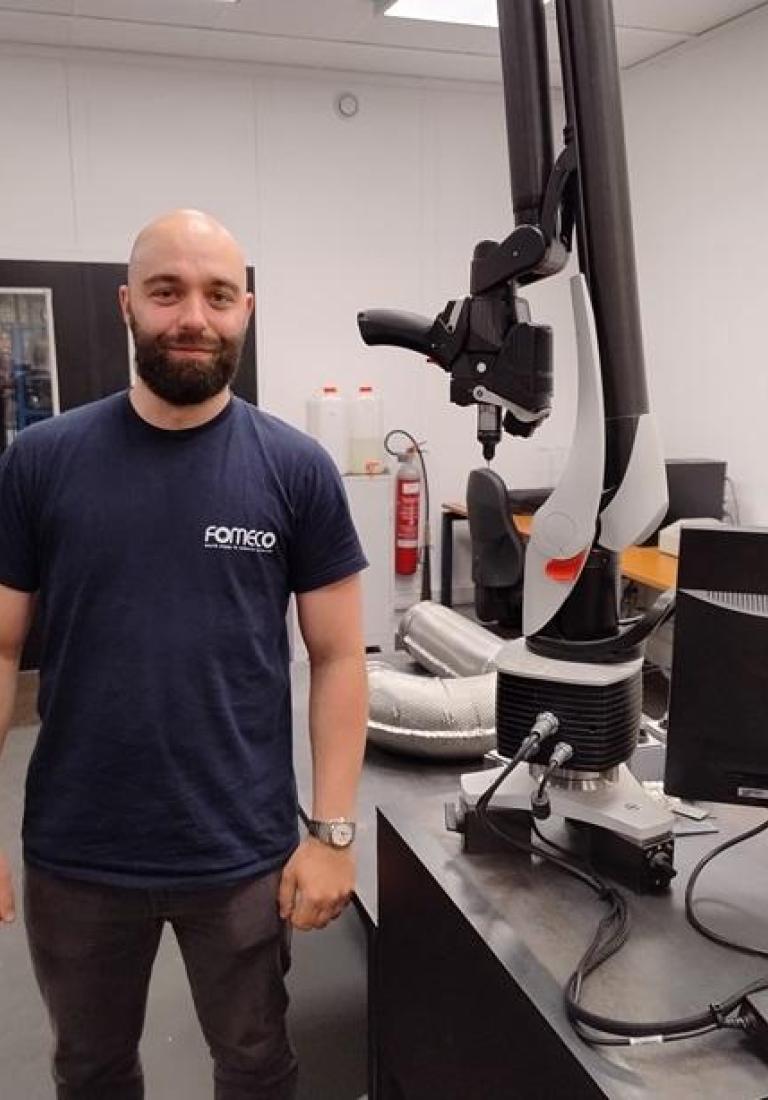
Krzysztof Kęsicki
Fomeco
From Poland
I came here mainly for economic reasons
"Life in Poland is not always easy. In big cities, the minimum income is around 750 euros net, while the rent for a one-bedroom apartment is 650 euros. Engineers with some experience earn between 1,250 and 1,800 euros. In Belgium, I’m better off.
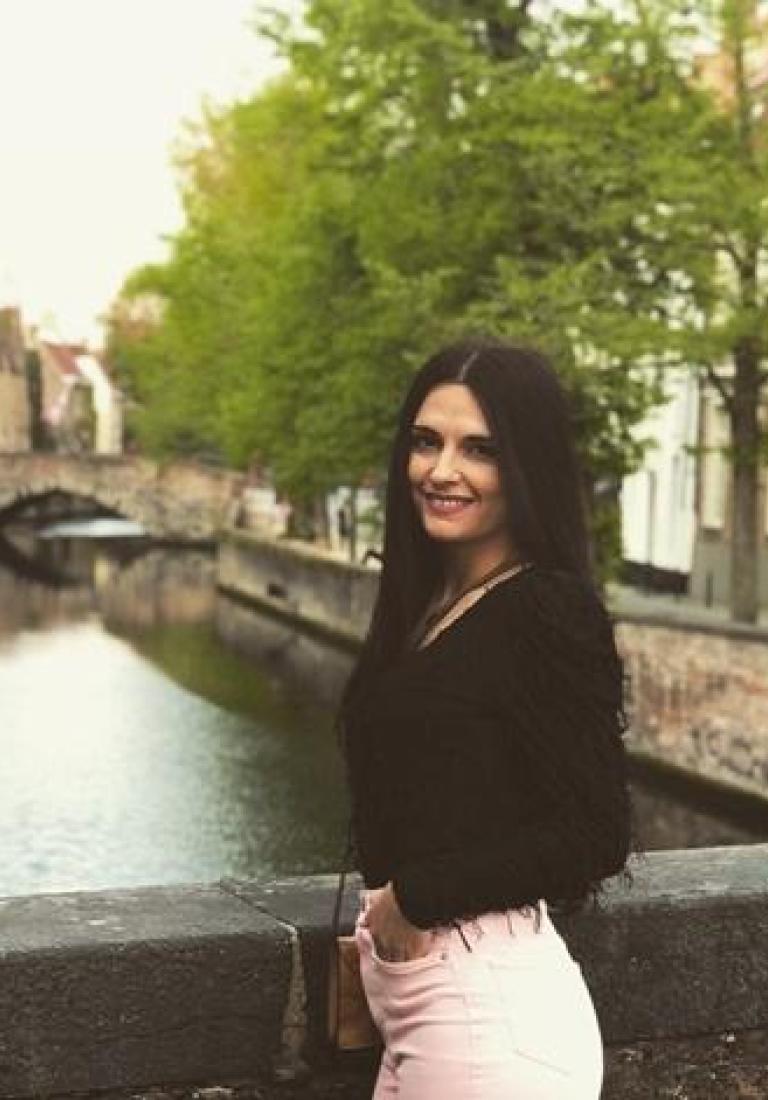
Anastasiya Rybina
Nipro Digital Technologies Europe
From Ukraine
I have a creative background as a graphic designer, but here I truly contribute to people's lives. Nipro, headquartered in Japan, is a world leader in kidney care. At Nipro Digital Technologies Europe, we develop process-driven dialysis software called Nephro Flow Product Suite. It offers a complete range of modules that can be configured to meet the increasing digital needs of each dialysis department. My grandmother passed away from kidney failure; she was unable to receive dialysis. This job gives me a lot of fulfillment.
I appreciate that Nipro is an international work environment, as I find interacting with people from different backgrounds incredibly enriching. I see myself as a global citizen. Having moved so many times, I have noticed that I can integrate into new places quite easily. I always learn the language right away to connect with the people. I focus on the positive aspects of a country and look for similarities rather than differences.
I have always been a fan of Belgians, but since the war in Ukraine broke out, I truly feel love for them. My father and his wife were still in Ukraine at the start of the conflict. The HR manager of our company encouraged and helped me evacuate them to Belgium. My father was an electronics engineer and is now working as a cleaner in a nursing home. He and his wife have since integrated well into Jabbeke. They have received so much support from strangers who have since become friends. I am extremely grateful for that.
Bruges is a beautiful city. Walking or cycling through it feels like a fairy tale, thanks to the swans, flowers, and top-notch art. I even enjoy the many tourists in the Market Square because they radiate so much happiness as they walk around. I am happy to pass on cultural experiences in my children's upbringing. Belgium also excels in providing good and affordable education.
I have been living in Belgium since 2011, with a two-year break. Belgians are generally polite and friendly. They are kind people who care about the feelings of others—even at work. Perhaps that is why companies here are so focused on employee well-being, offering flexible hours and many social benefits. The only downside is that three months of maternity leave is quite short compared to many other European countries.
“Behind every move is a story of courage and growth."
IHWF Testimonials
Li Li Chong from Malaysia
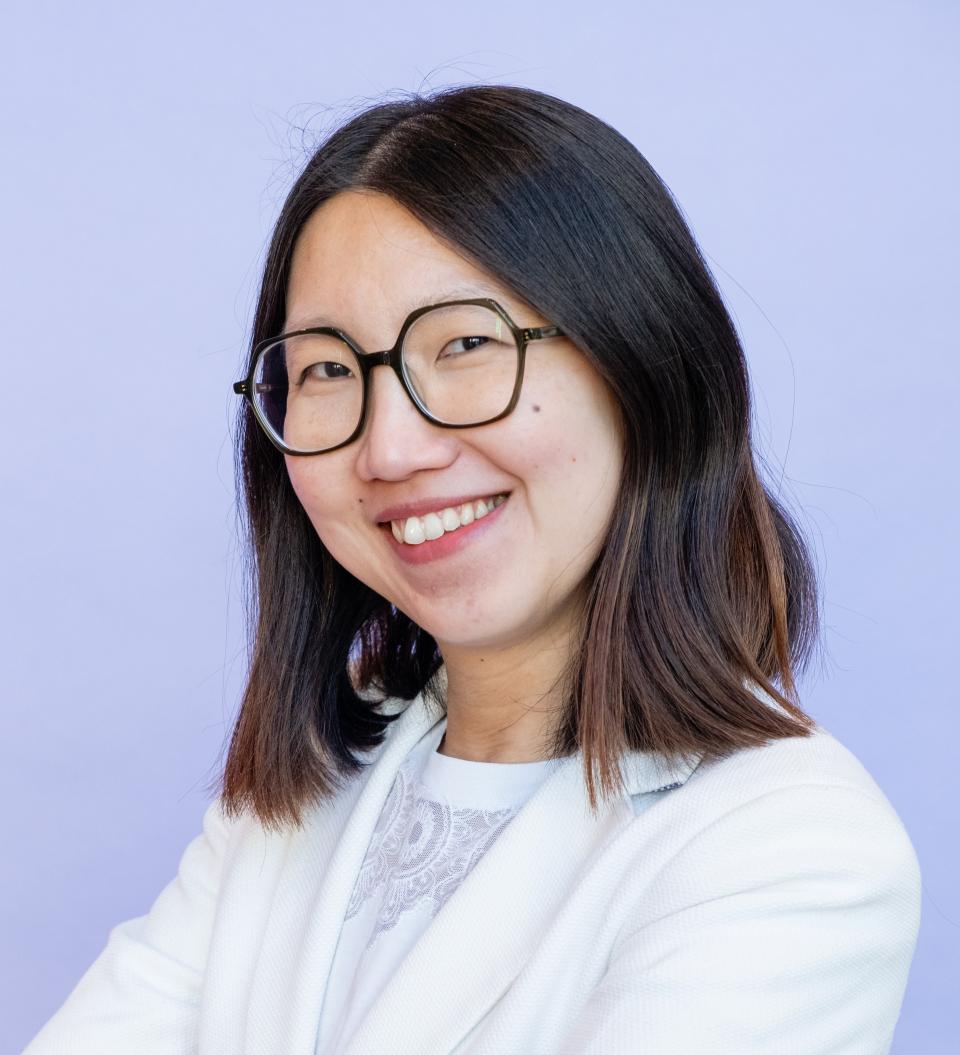
Li Li Chong is working in Concertgebouw Brugge as a Participation & Outreach Expert.
"I always enjoy Coffee Mornings where we can unwind together and get to know new international expats or locals from Bruges who are looking to connect with newcomers. We get to exchange contacts and tips with each other and further help people navigate their way into building a new life here.
I have learned that you are best here as your unique self. Wealth, I have come to understand, can also be defined by the relationships you build, the wisdom you share, and the support you give and receive. That is why I am such a strong supporter of the community-building and bridge-building mission of the International House West Flanders."
*photo copyright under Sightways
Mariela Ychante from Mexico
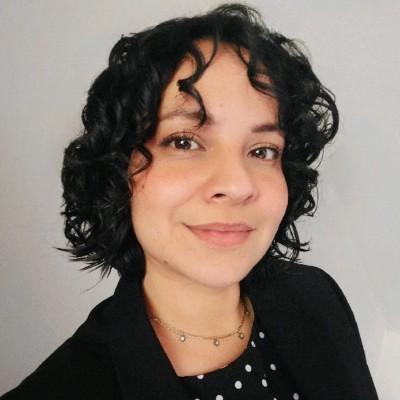
Mariela Ychante is working in Arteveldehogeschool as a Spanish lecturer.
"International House West Flanders has been a space to get to know other fellow newcomers in West Flanders. It is a great initiative to build a network and it is a door to a friendly community. The activities have helped to get to know people that have recently arrived but also some other people that have been here for longer. This has been key to exchange experiences and advice. I am excited to see more things coming for a more inclusive and more newcomers-friendly West Flanders."
Andrea Lowry from the US
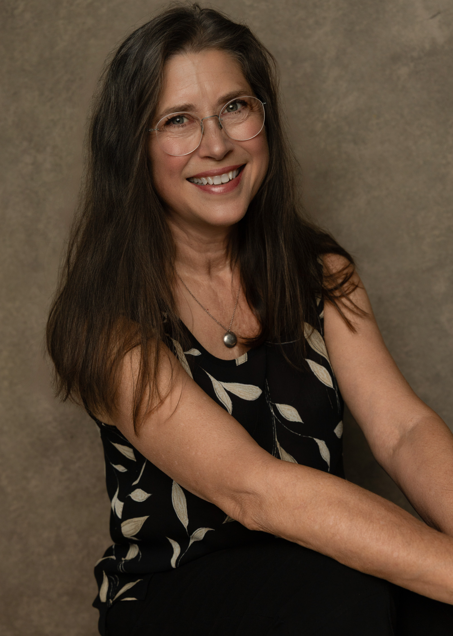
Andrea Lowry is working as a Clinical Music Therapist, Teacher, Singer-Songwriter,and Performer. She has rich experiences from moving around in Europe for the past 20 years.
"IHWF - is refreshing place to connect with people. At the coffee mornings, you meet local people from all backgrounds and experiences. The thing I like most about these meetings is that they are not just fun and informative, I feel like I can actually contribute something. In our last gathering, I hosted two rounds of conversation that were set-up well with Tanya's suggested questions.
It was easy to share about my projects with VZW's in Brugge. I found out fascinating stories of those at my table and also realised that I had met one of them 3 years ago in Oostende! It really feels like a small world when you share a table for the Coffee Mornings at IHWF. "
Jeff Alemdjou from Cameroon
Jeff Alemdjou is working in CNH as an Embedded Software & Robotics Engineer.
"The vibe was very chill and friendly, and people were really genuine, too. It was a speed-dating event but for making friends. You get to talk to someone new every once in a while. It is a fun way to connect with a bunch of new people in a short time. International House also invited us to join their upcoming events!"
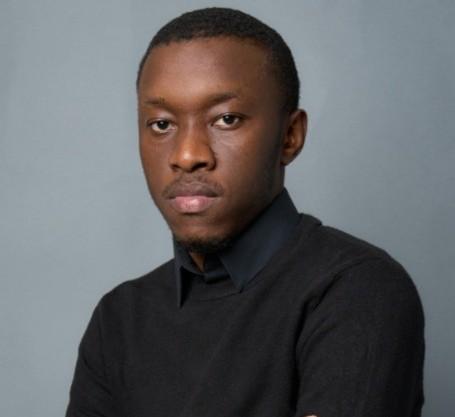
“Every story shared helps someone else take their next step.”
Voka Publications
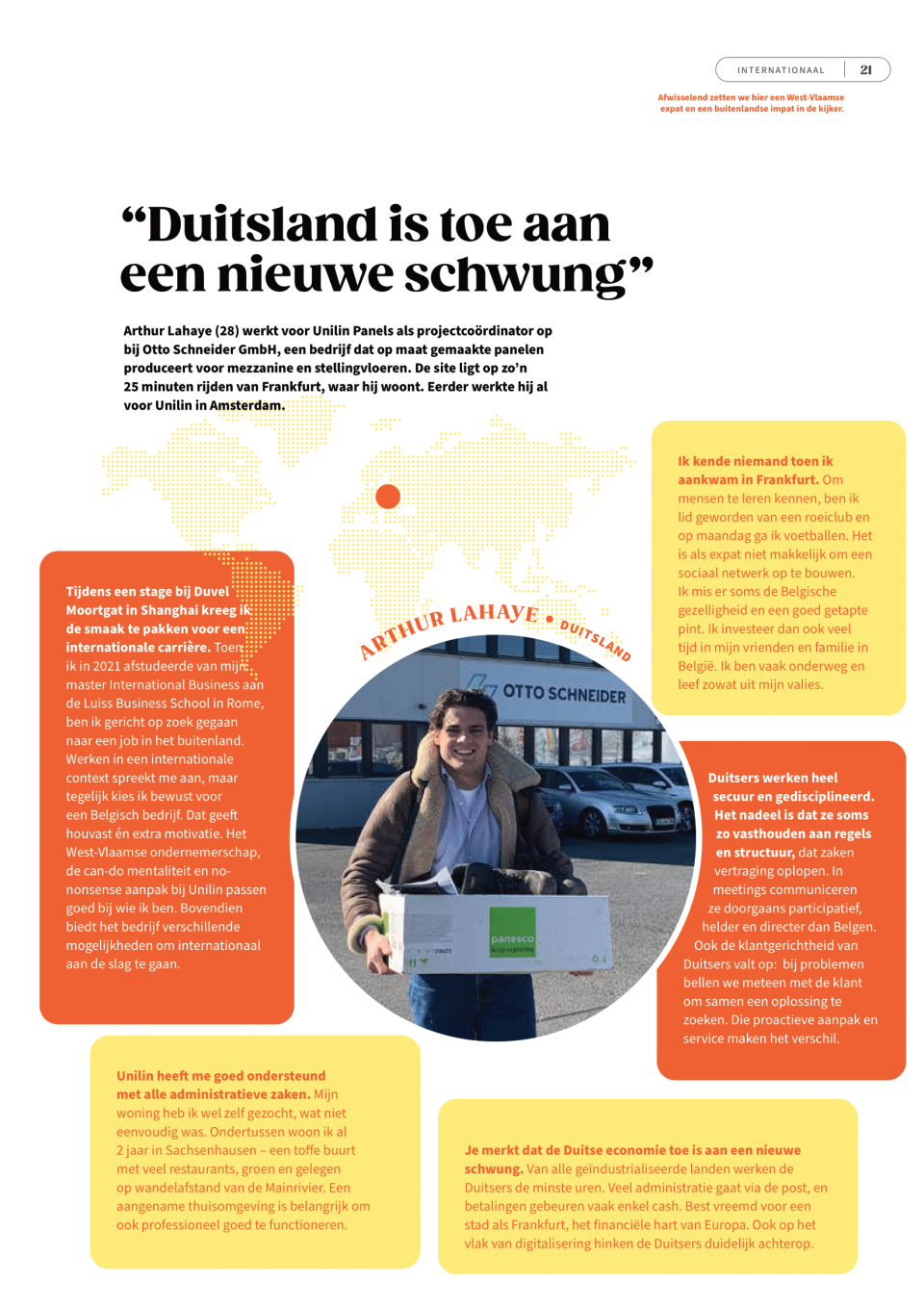
Arthur Lahaye - UNILIN
Translation:
"Germany is ready for a new lease of life"
Arthur Lahaye (28) works for Unilin Panels as a project coordinator at Otto Schneider GmbH, a company that produces custom-made panels for mezzanines and shelving units. The site is about a 25-minute drive from Frankfurt, where he lives. He previously worked for Unilin in Amsterdam.
During an internship at Duvel Moortgat in Shanghai, I got a taste for an international career. When I graduated with my master's degree in International Business from Luiss Business School in Rome in 2021, I specifically started looking for a job abroad. Working in an international context appeals to me, but at the same time, I consciously chose a Belgian company. That provides stability and extra motivation. The West Flemish entrepreneurship, can-do mentality, and no-nonsense approach at Unilin are a good fit for who I am. Moreover, the company offers various opportunities for international work.
Unilin provided excellent support with all administrative matters. I did search for my own accommodation, which wasn't easy. I've now been living in Sachsenhausen for two years – a great neighborhood with many restaurants, green spaces, and within walking distance of the River Main. A pleasant home environment is important for professional success.
I didn't know anyone when I arrived in Frankfurt. To get to know people, I joined a rowing club and play soccer on Mondays. As an expat, it's not easy to build a social network. I sometimes miss the Belgian conviviality and a well-poured beer. Therefore, I invest a lot of time in my friends and family in Belgium. I'm often on the road and practically live out of my suitcase.
Germans work very precisely and disciplined. The downside is that they sometimes stick so closely to rules and structure that things get delayed. In meetings, they generally communicate participatively, clearly, and directly than Belgians. Germans' customer focus is also striking: when problems arise, we immediately call the customer to find a solution together. That proactive approach and service make all the difference.
It's clear that the German economy needs a boost. Of all industrialized countries, Germans work the fewest hours. Much paperwork is handled by mail, and payments are often made in cash only. Quite strange for a city like Frankfurt, the financial heart of Europe. The Germans are also clearly lagging behind when it comes to digitalization.
Published in December 2025
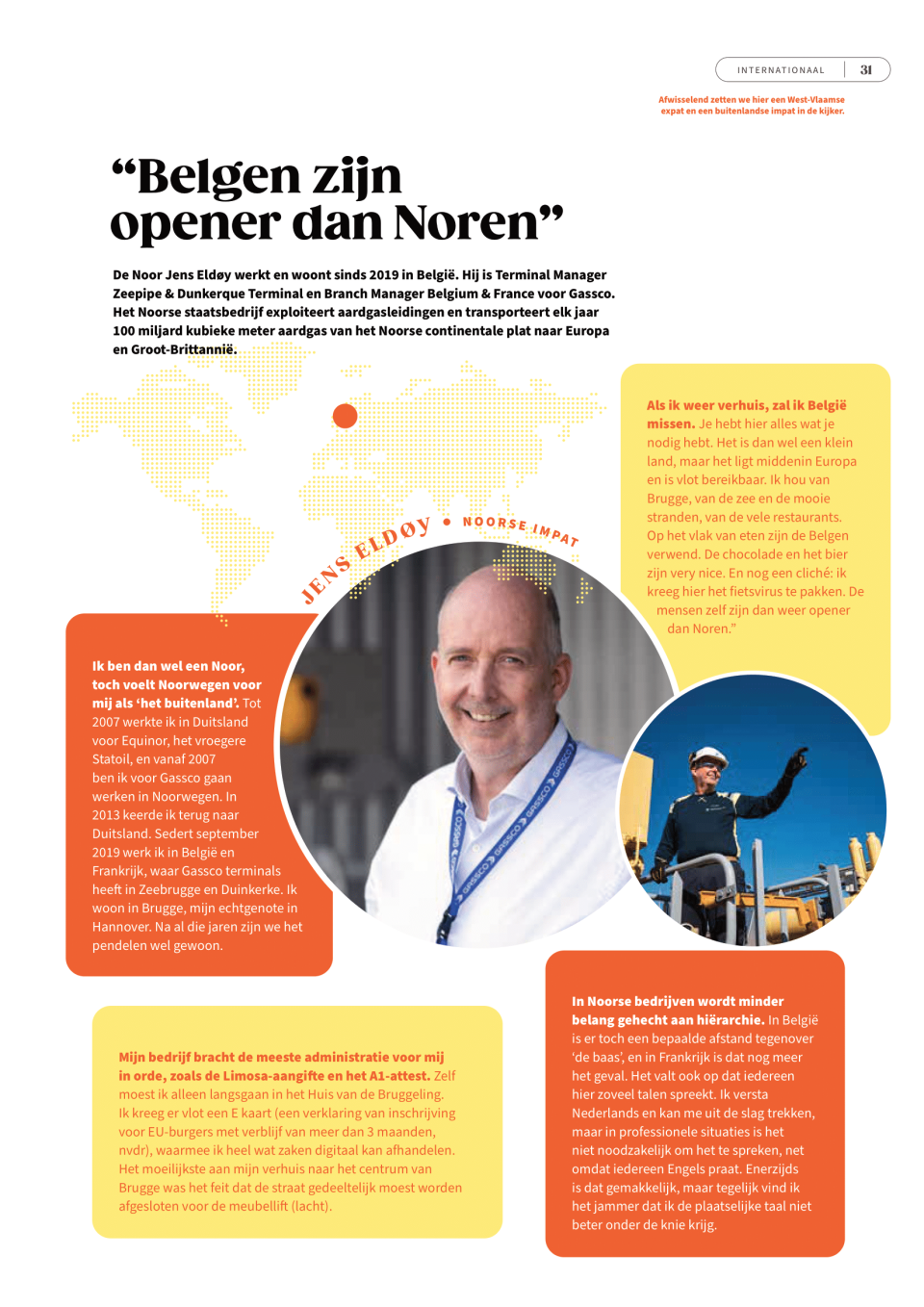
Jens Eldoy - Gassco
Translation:
"Belgians are more open than Norwegians"
Jens Eldøy, a Norwegian, has lived and worked in Belgium since 2019. He is Terminal Manager of the Zeepipe & Dunkerque Terminal and Branch Manager Belgium & France for Gassco. The Norwegian state-owned company operates natural gas pipelines and transports 100 billion cubic meters of natural gas annually from the Norwegian continental shelf to Europe and the UK.
Although I am Norwegian, Norway feels like "abroad" to me. Until 2007, I worked in Germany for Equinor, formerly Statoil, and in 2007 I started working for Gassco in Norway. In 2013, I returned to Germany. Since September 2019, I have been working in Belgium and France, where Gassco has terminals in Zeebrugge and Dunkirk. I live in Bruges, my wife in Hanover. After all these years, we've gotten used to commuting.
My company took care of most of the paperwork for me, such as the Limosa declaration and the A1 certificate. I only had to go to the Huis van de Bruggeling (House of the Bruges Residents). I quickly received an E-card (a registration certificate for EU citizens staying for more than three months), which allows me to handle a lot of things digitally. The hardest part about moving to the center of Bruges was the fact that part of the street had to be closed for the furniture lift (laughs).
If I move again, I'll miss Belgium. You have everything you need here. It may be a small country, but it's located in the heart of Europe and easily accessible. I love Bruges, the sea and the beautiful beaches, and the many restaurants. Belgians are spoiled when it comes to food. The chocolate and beer are very good. And another cliché: I caught the cycling bug here. The people themselves are more open than Norwegians.
In Norwegian companies, hierarchy is less important. In Belgium, there's still a certain distance from "the boss," and in France, even more so. It's also striking that everyone here speaks so many languages. I understand Dutch and can get by, but in professional situations, it's not essential to speak it, simply because everyone speaks English. On the one hand, that's convenient, but on the other, I regret not mastering the local language better.
Published in February 2024
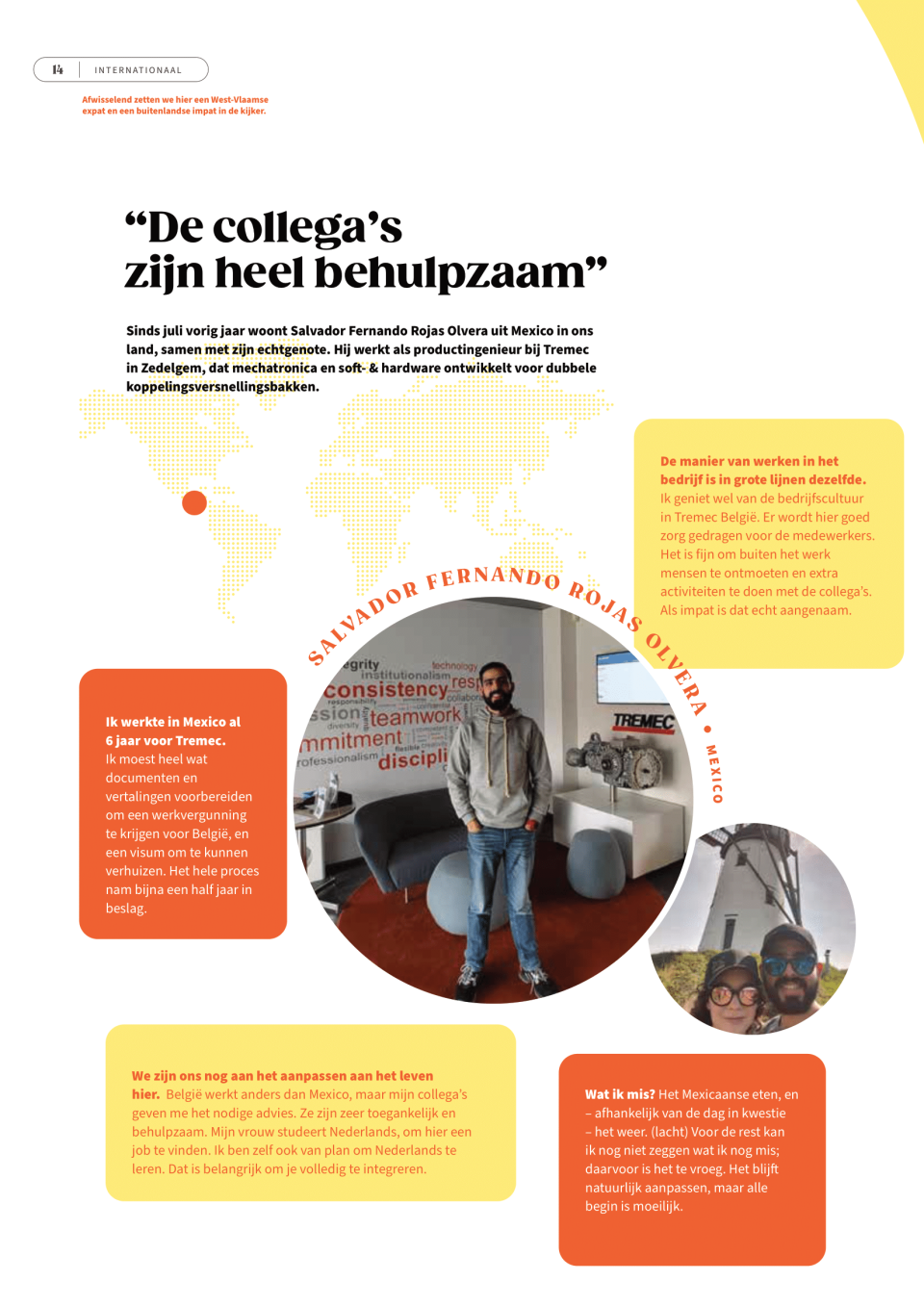
Salvador Fernando Rojas Olvera - Tremec
Translation:
"The colleagues are very helpful."
Salvador Fernando Rojas Olvera from Mexico has been living in Belgium with his wife since July of last year. He works as a product e gineer at Tremec in Zedelgem, which develops mechatronics, software, and hardware for dual-clutch gearboxes.
I had already worked for Tremec in Mexico for six years. I had to prepare a lot of documents and translations to obtain a work permit for Belgium and a visa to be able to move. The entire process took almost six months.
We are still adjusting to life here. Belgium works differently than Mexico, but my colleagues give me the necessary advice. They are very accessible and helpful. My wife is studying Dutch to find a job here. I also plan to learn Dutch. That is important for full integration. The way of working in the company is largely the same.
I do enjoy the company culture at Tremec Belgium. They take good care of their employees here. It's nice to meet people outside of work and do extra activities with colleagues. As an impat, that's really enjoyable.
What do I miss? The Mexican food, and – depending on the day in question – the weather. (laughs) Apart from that, I can't say yet what I miss; it's too early for that. It's still an adjustment, of course, but every beginning is difficult.
Published in April 2024
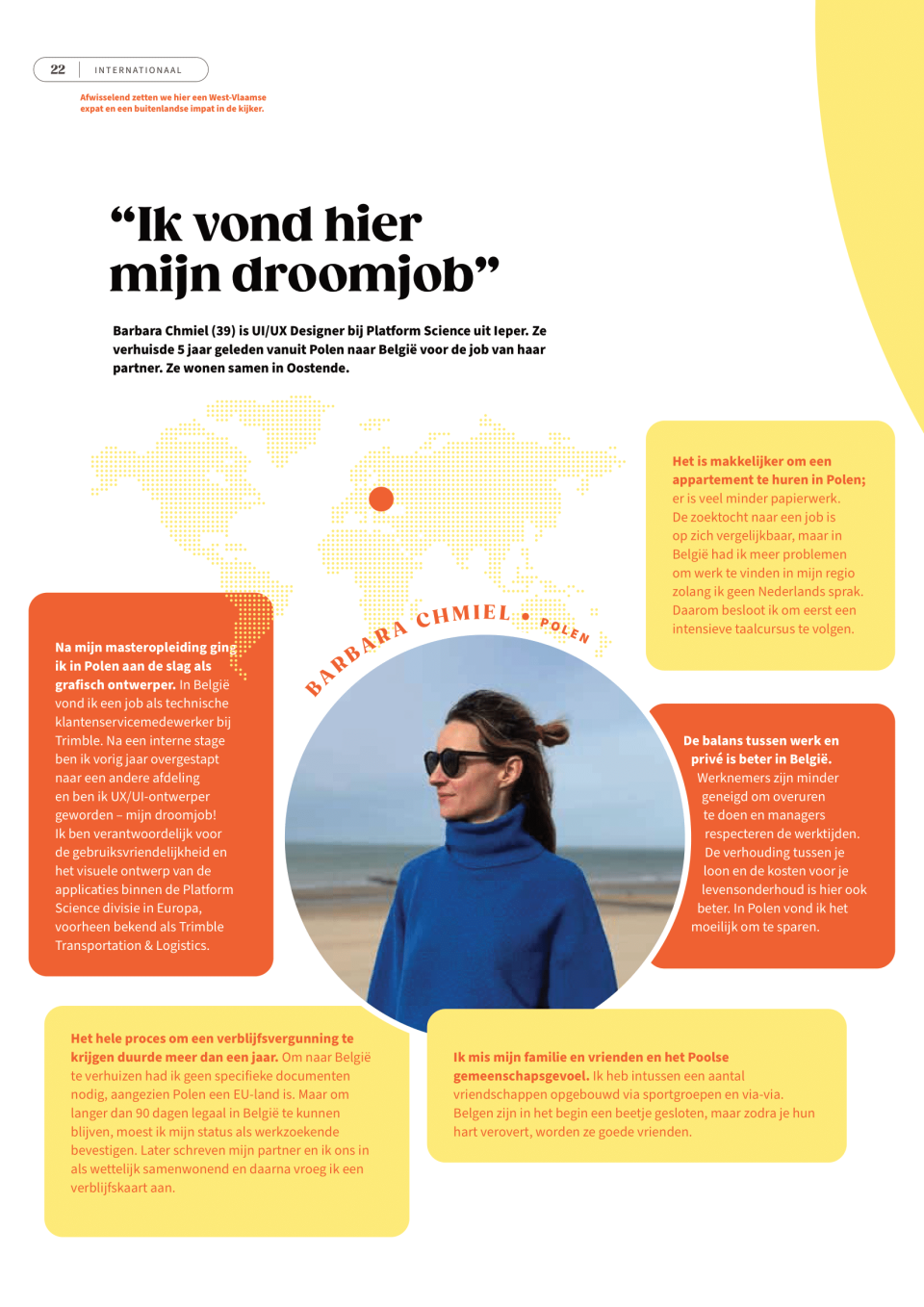
Fernanda Augusto - Nayan
Translation:
"Employees are more valued in Belgium"
Fernanda Augusto, a Brazilian woman, is 33 years old. In the spring of 2019, she followed love to Belgium. She has since married Jeroen, and they have three children together. Fernanda works in the finance department of Nayan in Ardooie, specializing in e-commerce, digital marketing, marketplaces, and customer experience. There, she progressed to become a controller.
My expat story began in June 2016. That's when I left Brazil temporarily to do an intercultural exchange in the US. I met Jeroen during a vacation in Miami. For various reasons, I didn't want to return to Brazil. I applied for Italian nationality (which is possible because my family has Italian roots), and started a long-distance relationship with Jeroen. After becoming an Italian citizen, I followed love and moved to Belgium.
Having European citizenship and living with a Belgian citizen made it easier to stay in Belgium. The integration course wasn't mand tory, and I could also continue looking for a job. I decided to take an intensive Dutch course for six months. That wasn't easy, but I had a lot of support from my husband, his family, and friends. I made (and still make) mistakes, but the people always remained friendly and polite. They were always so enthusiastic that I made the effort to learn their language, and that gave me a boost to want to learn.
Thanks to daily life with a Belgian citizen, integration went quite smoothly. The fact that I've lived in the US and Italy also helped. Belgium was a new country for me, but I already had experience with the changes in language, food, customs, etc.
In Belgium, more importance is placed on work-life balance. In Brazil, it's normal to be away from home from 6 a.m. to 8 p.m. Long workdays, traffic jams, learning new skills,…: it's difficult to combine everything. Due to the limited supply of well-educated people, employees are also more valued in Belgium than in Brazil, in my opinion.
I'm not a fan of the wet weather in Flanders. In Brazil, there are far fewer gray days than in Belgium – even in São Paulo, which Brazilians call "terra da garoa," or "land of the drizzle." The food is also completely different. In Brazil, rice and beans are the basis of our diet, and we usually eat meat twice a day. There are many Belgian habits that I've already integrated into my life, such as eating a sandwich as a full meal. In Brazil, bread is only breakfast or sometimes a "cheat meal." Now, as a mom of a 4-year-old boy and 3-month-old twin girls, I'm perfectly happy to indulge in some snacks every now and then!
Published in April 2025
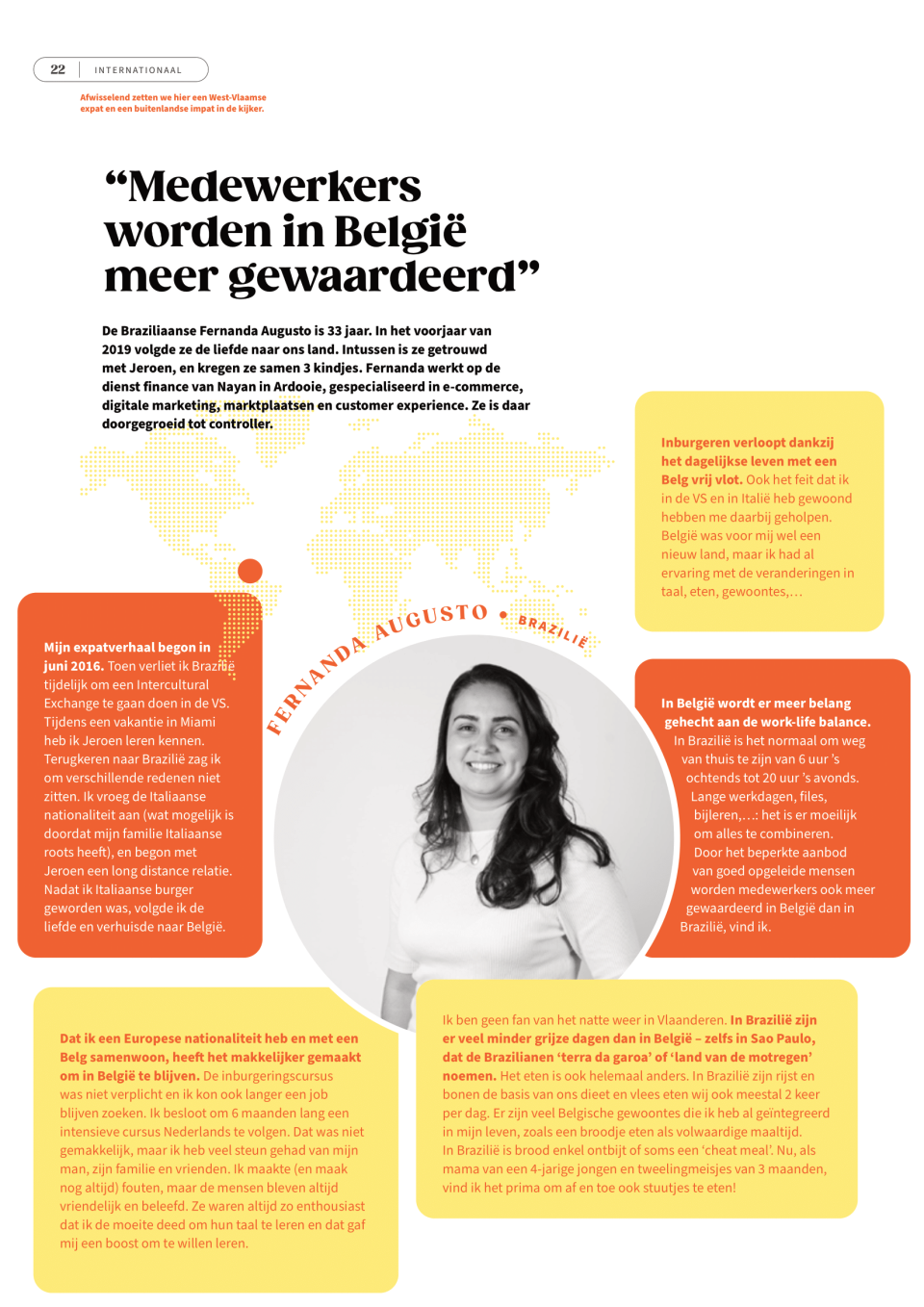
Karsten Foekens - Danneels
Translation:
"I sometimes get annoyed by the Dutch"
Karsten Foekens from Zierikzee ended up in Belgium when he was looking for a new adventure. He applied for jobs in Amsterdam and Berlin, among other places, but chose a job in Ghent. After that first Belgian work experience, he started working for the Bruges-based project developer Danneels, where he has now been CEO for almost four years.
When I moved to Belgium 8.5 years ago, I didn't know anyone here. I was tired of my job in Rotterdam and was looking for a new experience. I first moved to Ghent – where I worked at the time – and have since moved again. I work in Bruges and live
in Antwerp. It's a city with international appeal that is also easily accessible from Breda, Rotterdam, Ghent, Zierikzee, and Bruges.
I don't really consider myself an expat. I started working in a neighboring country, didn't have to learn a different language or
culture, and the administrative hassle wasn't too bad, all things considered. The most striking thing was that the local police officer had to visit – we don't have that custom in the Netherlands. I have a few good Belgian friends, whom I met when I first moved here, but my largest group of friends is still in the Netherlands.
The cliché is true: Dutch people say what they think. That way, you quickly know where you stand. Flemings are more cautious, more reserved. On the one hand, I consider it my strength that I dare to say things, but on the other hand, I've had to curb that directness a bit. By the way, I now understand that Flemings find the Dutch a bit rude, loud, and arrogant. I didn't see it before, but now I'm starting to annoy myself. (laughs)
In Belgium – and especially in West Flanders – the urge to be enterprising is strong. People dare to take (calculated) risks and have ambition to grow. I also feel a bit freer here. Because contrary to what Flemish people think, there are still many more rules and fines in the Netherlands. They are strictly followed, while Flemings are more creative with them.
Published in June 2024.
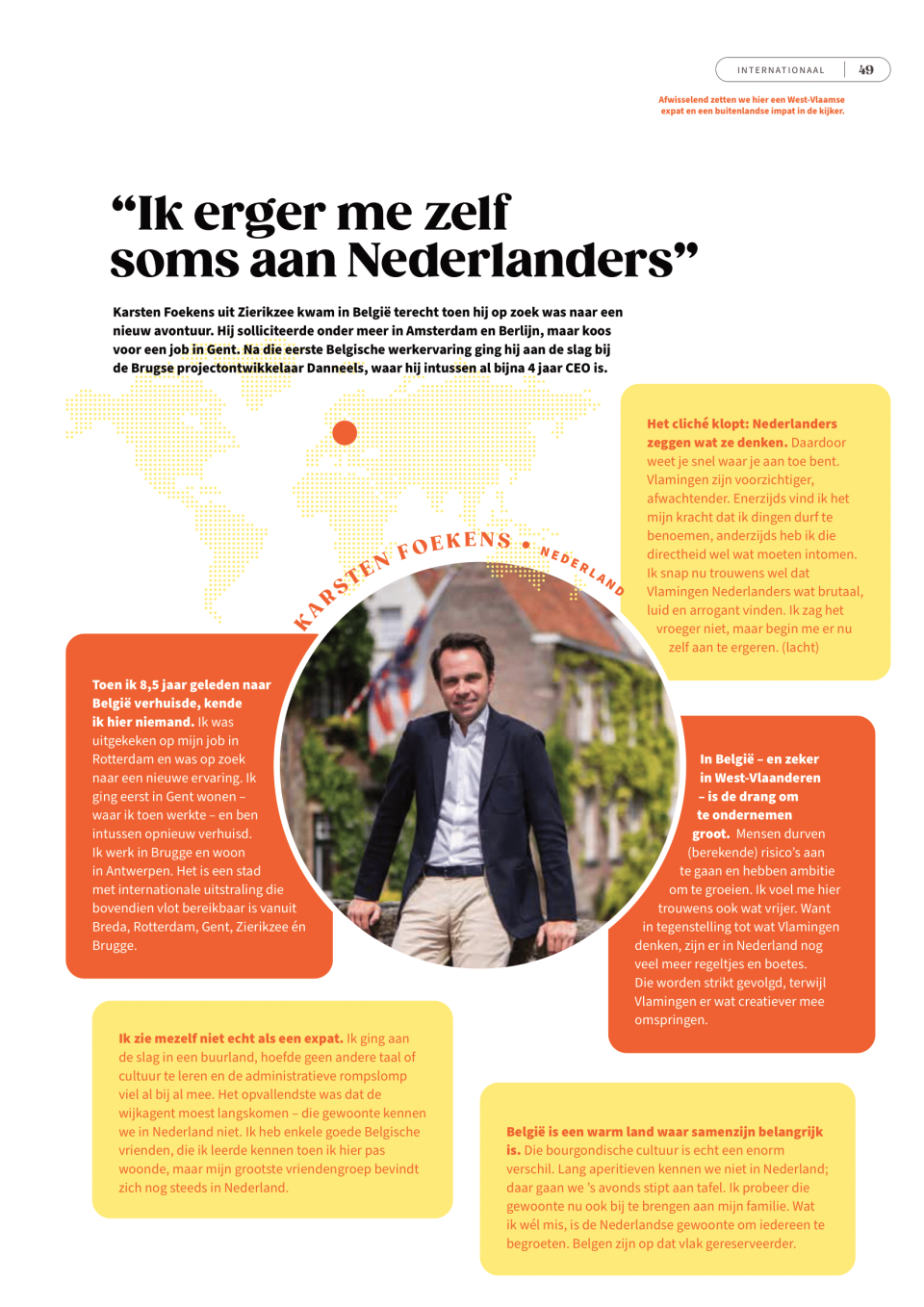
Regis Andre - Cebeo
Translation:
"I appreciate the positive spirit in Flanders"
Régis André has been CEO of Cebeo since January 1, 2021. The electrical wholesaler for all electrical equipment employs more than 1,000 people. The company is part of the international Sonepar group, for which Régis André previously worked in France.
I'm from Paris, but I didn't really know Belgium. My new job was not only a professional challenge for me, it was also an opportunity to discover a different culture and language. That's why I consciously chose to live in Flanders, even though Cebeo's headquarters in Waregem is not far from France and Wallonia. My wife still works in Paris. She spends one out of three weekends with me in Belgium, and on the other weekends I go to France.
Flanders is richer than France: you can see this, for example, in the quality of the houses. As a result, the Flemish market is more mature and sophisticated than the French. It is also a denser area, which means the level of service is higher than in France.
Belgium is an interesting market for testing new developments. It is a small country with a sophisticated, demanding and complex market, and with well-educated and multilingual people. This makes Belgium an ideal test platform. The new online shop of the Sonepar Group, for example, was co-designed and first tested in Belgium.
Flemish people are more to the point and communicate more directly. The French always beat around the bush to get their message across. Before a meeting starts, in France, there is a lot of chatter; in Flanders, attendees are working on their laptops. They are professional and efficient, but at the same time, they are also somewhat colder than the French.
There's a more positive spirit here than in France. I really appreciate the optimistic attitude of the Flemish, as well as their sense of humor. The French are more critical and rarely happy. I've received a good and warm welcome here. Everyone makes an effort to speak French, while I speak a little Dutch myself. The 40 hours of lessons I took are of course not enough. That's why I practice every day on Duolingo.
Published in August 2024.
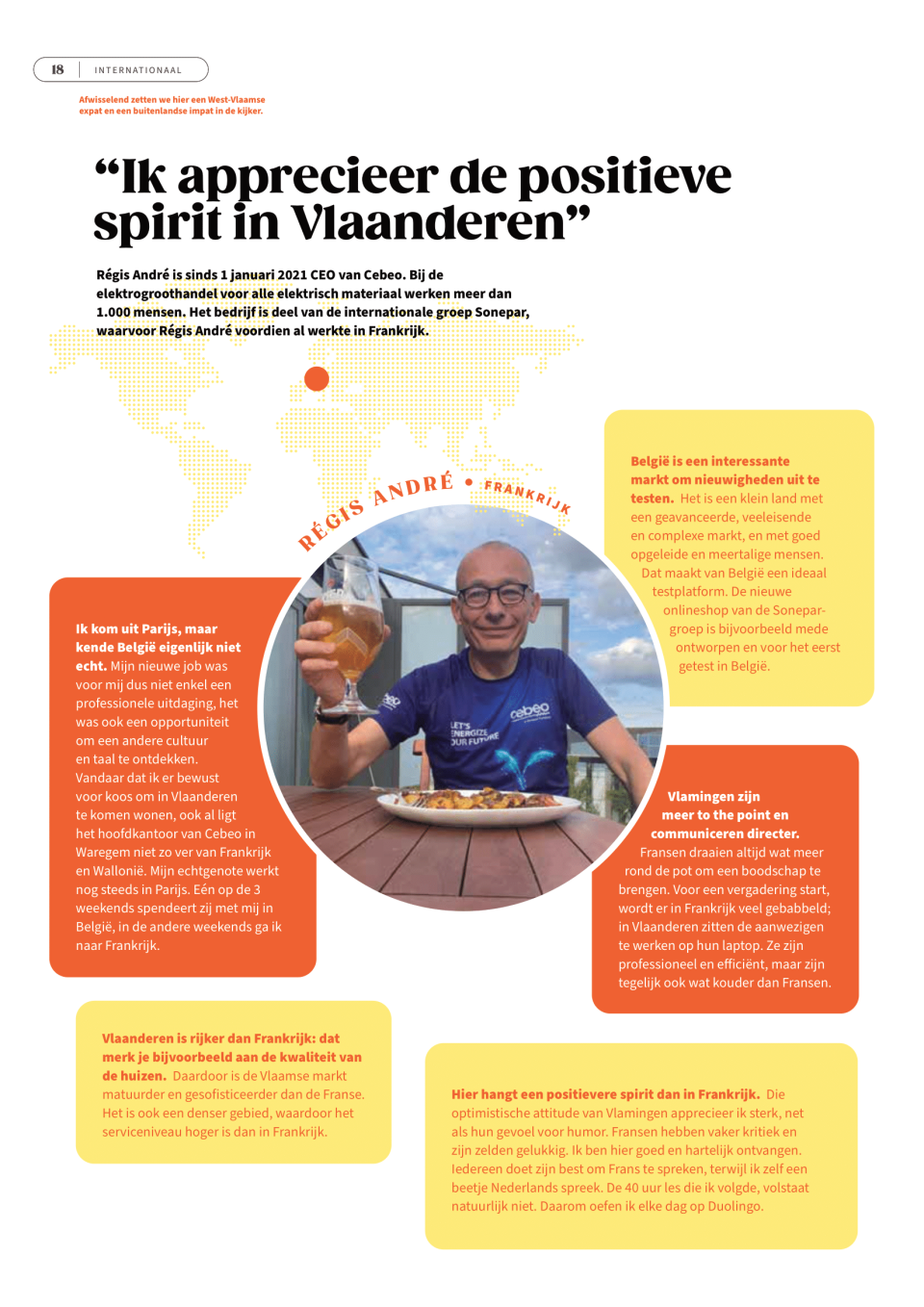
Barbara Chmiel - Platform Science
Translation:
"I found my dream job here"
Barbara Chmiel (39) is a UI/UX Designer at Platform Science in Ypres. She moved from Poland to Belgium five years ago for her partner's job. They live together in Ostend.
After completing my master's degree, I started working in Poland as a graphic designer. In Belgium, I found a job as a technical
customer service representative at Trimble. After an internal internship, I transferred to another department last year and became a UX/UI designer – my dream job! I am responsible for the usability and visual design of the applications within the Platform Science division in Europe, formerly known as Trimble Transportation & Logistics.
The entire process of obtaining a residence permit took more than a year. I didn't need any specific documents to move to Belgium, as Poland is an EU country. But to stay legally in Belgium for more than 90 days, I had to confirm my job-seeking status. Later, my partner and I registered as legally cohabiting, and then I applied for a residence permit.
It's easier to rent an apartment in Poland; there's much less paperwork. The job search process is similar, but in Belgium, I had more trouble finding work in my region as long as I didn't speak Dutch. That's why I decided to take an intensive language course first.
The work-life balance is better in Belgium. Employees are less inclined to work overtime, and managers respect working hours. The ratio between your wage and living expenses is also better here. In Poland, I found it difficult to save.
I miss my family and friends and the Polish sense of community. I've since built up a number of friendships through sports groups and word of mouth. Belgians are a bit reserved at first, but once you win their hearts, they become good friends.
Published in August 2025.
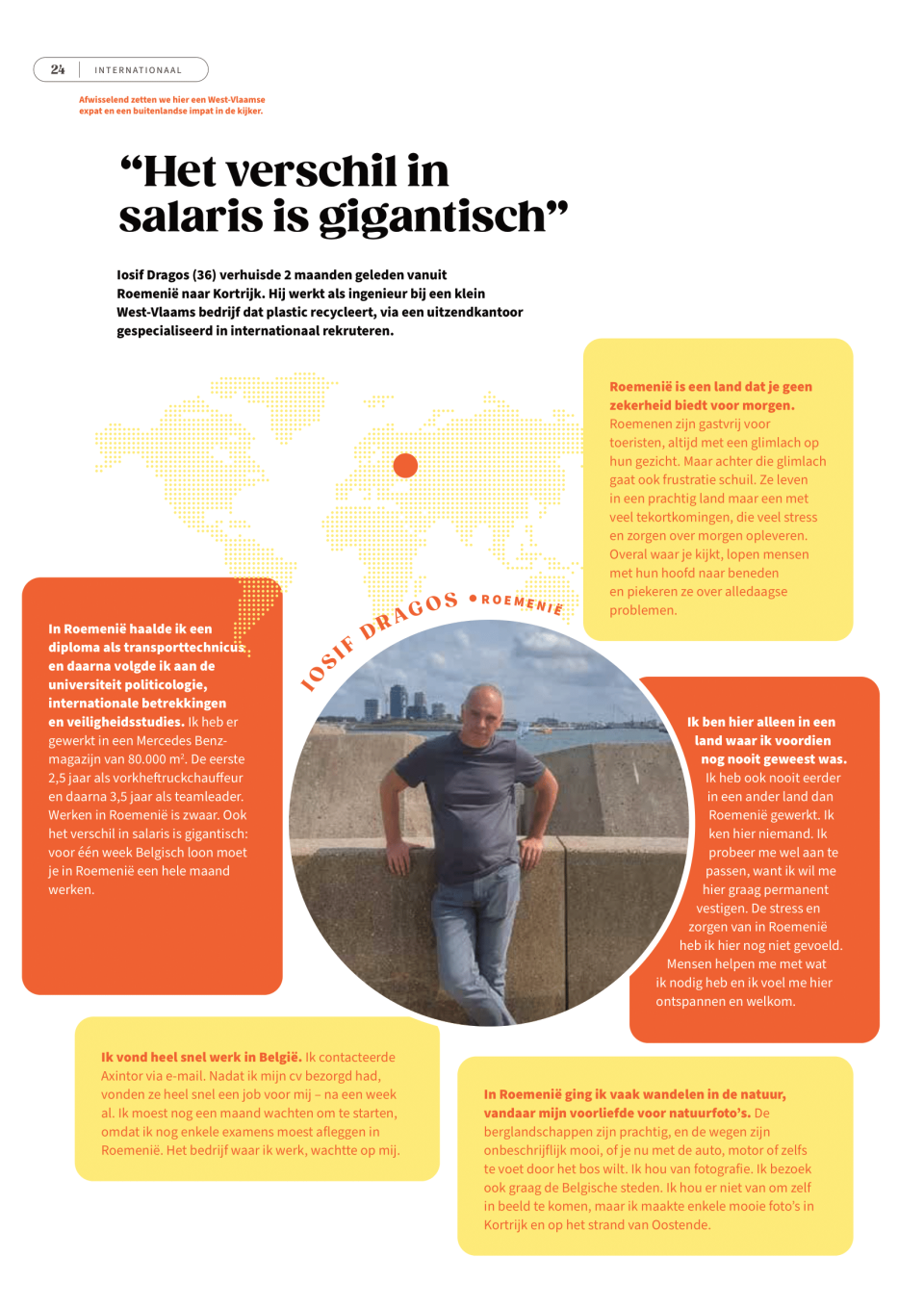
Iosif Dragos
Translation:
"The difference in salary is enormous"
Iosif Dragos (36) moved from Romania to Kortrijk two months ago. He works as an engineer at a small West Flemish company that recycles plastics, through a temporary employment agency specializing in international recruitment.
In Romania, I obtained a diploma as a transport technician and then studied political science, international relations and security studies at university. I worked there in an 80,000 m² Mercedes-Benz warehouse. The first two and a half years as a forklift driver and then three and a half years as a team leader. Working in Romania is tough. The difference in salary is also enormous: for one week's Belgian salary, you have to work a whole month in Romania.
I found work in Belgium very quickly. I contacted Axintor by email. After I submitted my resume, they found me a job very quickly—after just one week. I had to wait another month to start, because I still had some exams to take in Romania. The company where I work was waiting for me.
Romania is a country that doesn't offer certainties for tomorrow. Romanians are welcoming to tourists, always with a smile on their faces. But behind that smile also lies frustration. They live in a beautiful country, but one with many shortcomings, which cause a lot of stress and worries about tomorrow. Everywhere you look, people walk with their heads down and worry about everyday problems.
I'm here alone in a country I've never been to before. I've also never worked in any country other than Romania before. I don't know anyone here. I'm trying to adapt, because I want to settle here permanently. I haven't experienced the stress and worries I had in Romania here yet. People help me with what I need, and I feel relaxed and welcome here.
In Romania, I often went hiking in nature, hence my love for nature photography. The mountain landscapes are stunning, and the roads are indescribably beautiful, whether you go by car, motorcycle, or even on foot through the forest. I love photography. I also enjoy visiting Belgian cities. I don't like being in the picture myself, but I took some beautiful photos in Kortrijk and on the beach in Ostend.
Published in June 2024.